Skip to content

Societas Sancti Francisci Salesii

Salesians

The Salesian Society, founded by Fr. John Bosco in Turin in 1859, is one of the largest male religious congregations in the world.

Founder

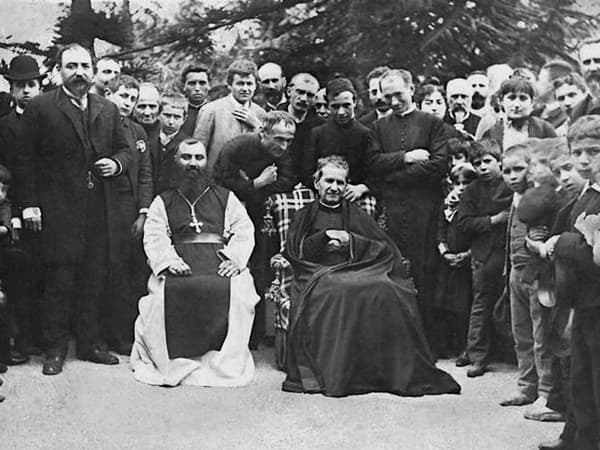
St. John Bosco (1815-1888)

father and teacher of youth

in 1815 August 16 In Italy, in the settlement of Beki, Margarita and Francesco Bosco's youngest son, John, was born. After the sudden death of his father, two-year-old Jonukas was left with two older brothers, a sick grandmother and mother.

From the first "oratories" in the village barns, where the neighbors gathered in winter listened to him read tales about the kings of France, Jonuks considered prayer the main purpose of bringing children and adults together. At the Kjeri seminary, Jonas worked hard to get the 60 lira bonus. The rest of the money was earned by shaving someone's beard, mending clothes or sewing.

in 1841 on May 26, the day of celebrations, writes in his notebook: "A priest does not go to heaven or hell alone. If he does good, he will go to heaven with all the souls he has saved by his good example. If he does bad, he will offend others, perishing together with the souls condemned because of his outrages. Therefore, I will try to fulfill these promises: I will always be busy, for the salvation of souls I will suffer, I will humble myself everywhere and in everything, I will always be guided by the love and affection of Saint Francis de Sales."

He is now priest John Bosco. Advised by priest Kafaz, continues his studies in Turin. At St. Francis of Assisi Church prepares priests. On days free from lectures, they serve in hospitals and prisons, deliver sermons, listen to confessions, teach catechism, and nurse the sick. J. Bosko visits the poor suburbs, where he sees a prophetic childhood dream: ragged, exhausted children cursing and fighting. And the other priests are worried: in the past, the children of Turin used to come to the sacristy to learn catechism. Now the sacristy and parsonage are empty...

Oratorios

It is necessary for the priests themselves to go out to the children: to the streets, markets, factories. There is a network of oratories in Milan. In Brescia, Fr. Ludvikas Pavonis established an oratory for "poor, unpolished and despised" boys back in 1809. The pastors of Turin are on the lookout, but the young priests of the boarding house are already looking for a way out. Giovanni Cochi founded the first Sunday Oratory in Turin in 1841 in Moschino, the poorest farmhouse with a bad reputation. Father Kataz wants to organize a center where abandoned boys and prisoners can find help. J. Bosko seeks the same. Unexpectedly persuaded, the sixteen-year-old in the lime-washed mason's clothes helps to organize the Oratory of the Little Masons. A week later, he came to the priest, who knows how to whistle, with nine friends.

The number of guys is increasing. The day is long, something needs to be done. Three months pass - they are already twenty-five, and by the summer - eighty. Bosco tries to avoid trouble, takes the children to the hills, to the river, to the sanctuaries of Mary. In the first winter, the boys who were most at risk were invited. Every Saturday, stuffing his pockets with tobacco, fruit, and buns, he went to the prisons to become a friend of the prisoners. The priest tried to place former prisoners with honest craftsmen, he often visited them.

The boys were attracted by the young priest's sincerity, cheerfulness, and kindness. He understood how important it was for them to somehow pour out their own: "Play, jump, do whatever you want, just don't sin."

In the summer of 1844, J. Bosko was transferred to Valdokas, where the oratory has a wider space. Children are everywhere: in the yard, on the stairs, Fr. Bosco and Fr. in Borel's rooms. Everyone "made order" in their own way. On Sundays, about two hundred teenagers lined up and solemnly marched with both priests to St. Mass to the church.

December 8 is a solemn day. Children are invited to their chapel. J. Bosko writes: "Holy Mass was offered, many boys made confession and received Holy Communion, and I wept because it seemed to me that a solid foundation had already been laid for the oratory." On that day, the oratory was named St. In the name of Francis Sales. The features of Bosco's oratorio are already forming: with noisy games and outbursts of joy. It differed from other oratories, where the children met with the leader for several hours, everyone attended Mass in their own parish, their parents brought them to the oratory, guaranteeing good behavior. And J. Bosko spent the whole Sunday with his children, met every evening in classes and St. Everyone attended mass together. In addition, he visited children in the workplaces and began with prisoners, abandoned and dangerous children who were most in need of care. He fed the poorest and accepted them to live with him. Mother Margarita sold her jewels and gave the money to the food of "Jonuka's children". In 1853-1861, J. Bosko opened cobblers', tailors' and carpentry's workshops, a bookstore and a printing press next to the oratory in order to involve young people in work. Later, he set up a locksmith workshop.

In 1855, during the Feast of the Annunciation, the prophetic dreams finally came true - priest J. Bosko founded the Salesian Congregation. Its first member is Mykolas Rua, the same eight-year-old boy to whom, at the beginning of the creation of the oratorio, during one of the meetings with the children, when he no longer had to give the medallion of Mary, J. Bosko stretched out his left hand saying: "Take it, Mikelin, take it!", and crossed it with his right hand: "We will share everything in half".

Children needed to be fed, taught, clothes needed, rooms for some to live in, bedding, an outdoor playground, a church for daily prayers and work. However, Fr. Few admired Bosco's charity. He was often "nailed to the cross", suffered contempt, was called a thief and a madman, but he did not doubt his mission. Mother Margarita, who has been around since childhood, came to live with her son when the children needed help. And she spent the last moments of her life mending children's clothes, baking, cooking and comforting them.

But Bosco was not alone. He felt the protection of God and His Mother all the time. And in easier cases, people helped. This is Fr. Liakuris, who lent books to the first "barn oratory"; Fr. Kaloz, who became the first spiritual guardian, seminary friend Liudžis Komolas, the great educator of the soul. During the time of the Oratory, close helpers were several priests, especially Fr. Kafas and "father" Fr. Borel. Bosco also received help from the laity. Those men and women of good will helped fulfill the tasks set by Jesus and Mary in the visions.

Missions

In 1871-1872, J. Bosko dreamed of "wild" lands. A year later, the dream repeated with the desert and very cruel people. Thoughts about missions did not give me peace since the days of the seminary, and invitations kept coming from different countries. It's time to travel. Remembering the dream, Bosko recognizes South America, Patagonia, from geography books and maps. In 1874, the Archbishop of Buenos Aires invited the Salesians. Volunteers gather in Valdokas. J. Bosco selects six priests and four coadjutors. Giovanis Kaljeris, a 37-year-old extremely active priest, graduate theologian, clergy professor, music teacher and composer, is appointed as the leader. November 11th. The sanctuary of Mary's Christian Help and the square in front of it are full of people. "Find the brothers driven by poverty to a foreign country. Then you will have to evangelize Patagonia", are the words of the "father" who is leaving. In total, J. Bosco organized eleven missionary expeditions, but the first one was the strongest.

In Buenos Aires, the missionaries founded a Sunday Oratory and started to build schools. Reached Uruguay. They found no signs of Catholicism there either. Father Caljer decided to establish a vocational school, the first Christian college in Montevideo, the capital of Uruguay, and to start working with the children of La Bosa, the poorest district of Buenos Aires, which was ruled by Masons.

In 1877, J. Boskas prepared the first issues of "Salesian Knowledge". Since then, "Salesiečiai žinios" has been telling about the Salesians, their missions and the great graces of the Christian Help of Mary, and gathered collaborators. That year, J. Bosco sends an expedition of young Salesians. It is called the "children's crusade". The daughters of the Maria Christian Help of Christians Convent, founded by J. Bosko, left together.

In 1878, the archbishop of Buenos Aires sent vicar Monsignor Espinosa and two Salesians to the lands of the Indians. The journey of the Salesian priests and the vicar by steamer from Parana ended in a storm at sea, from which they had barely returned. Another trip to the Indians took place a year later with an army unit moving there. Missionaries travel through the Pampas desert about 1300 kilometers riding and wobbly carts, baptizing the Indians. A whole month traveled through the desert to the Rio Colorado River. Here, St. Mass and a trip again, already with troops. In 1879, the Bishop of Buenos Aires commissioned Fr. J. Bosko.

House of God and Gate of Heaven

Fr. J. Bosko also built churches. The first one was consecrated in 1852 - it is the Salesians' Porciunkule. The second one, the Basilica of the Help of Christians of Mary, was built next to it in 1868. In 1880, he built two churches - in Turin and Valecrozia. But the three Salesian houses in Marseille, Nice and Spezia remained unfinished.

St. was having a hard time in Rome. Construction of the Church of the Heart. Cardinal Alimonda said to Pope Leon: "Leave it to Father J. Bosco. He will agree." Yes, he did not resist, although he was not very strong. Begging begins in Italy, Spain, France. J. Bosko went to Paris almost blind, he could barely stand on his feet (suffering from varicose veins). Fatiguing trips, meetings with people, little rest. Queues of carriages awaited the audience with the miraculous priest. Affectionately received by the rich of Paris and the authorities of the Church. Everyone donated. But that one time in France was not enough to build a church. He drove again, already completely sick, accompanied by his disciples, risking his life.

St. The Church of the Heart in Rome was consecrated in May 1887.

Fr. J. Bosko died on the night of January 31 of the following year, at the age of 73.

Young Salesians - Italians, French, Poles, Lithuanians - will hurry from Turin to Argentina, Uruguay, Brazil, Chile, Ecuador, Africa, Beijing, Hong Kong, Calcutta, Madagascar. They will build their homes and universities there. The honor and the will of God of a great man of a small Italian village will also reside there.

Priest J. Bosko was declared a Servant of God in 1909, blessed in 1929 and a saint in 1934. April 1st, during Easter.

Preventive system

Don Bosco created a preventive education system based on three pillars: reason, religion and love. Instead of punishment and repression, this system encourages youth to grow through a positive relationship with an educator, a conscious practice of faith, and a rational understanding of why certain values ​​are important.

St. J. Bosco's letter from Rome

My dearest nephews J. Kr.

Far away or near, I always think of you. I have only one desire, to see you happy in time and eternity. That thought and that desire prompt me to write you this letter. My dears, it's hard for me to be away from you. You cannot imagine what a pain it is for me not to see or hear from you. I wanted to write these lines a week ago, but constant work prevented me... However, although I will return in a few days, I want to reach you by this letter before I can do it in person. These will be the words of one who loves you passionately in Jesus Christ and must speak to you freely as a father. And you let me do that, don't you? And you will take note of what I say and put it into practice.

Oratorio 1870 years ago

I already said that I think about you all the time. So one evening I went into my room, and as I was getting ready to go to bed, I began to say the prayers my good mother had taught me.

Suddenly, I don't know if I was dozing off or distracted, but it seemed to me that two old pupils of the oratory had introduced themselves.

One of them came up to me and greeted me sincerely and said:

"Oh, Don Bosco, do you know me?"

  • Of course, I know - I answered.

  • And you still remember me? another man added.

"And you and everyone else." You are Valfre and you were at the oratory 1870 years ago.

"Tell me," continued the man, "do you want to see the young men who were in the oratory then?"

  • Yes, show them to me - I answered - it will be a great joy for me.

Then Valfre showed me the youths, all of the same age and appearance as they had been in the old days. It seemed to me that I was in the old oratory during a recreation. Alive, active, cheerful. Who runs, who jumps, who dances. Here they play frog, there they race or throw a ball. In one place, a group of boys is listening to a priest telling a story, in another, a cleric is playing with the children, donkey flying or craftsman. Singing, laughing in all corners, priests and clerics everywhere, and young people are merrily bustling around them. It was seen that the young people and the elders share the greatest sincerity and trust. I admired the sight, and Valfre said to me:

  • You see, friendship awakens love, and love awakens trust. It opens hearts and young people fearlessly tell their teachers, assistants and elders. They are open in confession and elsewhere, and obediently do what the one they feel they love tells them to do.

Oratorio in 1884

Here another old pupil of mine came up to me with a completely white beard - it was Giuseppe Buzzetti - and asked:

  • Don Bosco, do you want to know and see the young people who are now in the oratory?

  • Of course I want to - I answered - after all, I haven't seen them for almost a month!

And he showed them to me. I saw them all during recreation. However, I heard no cheers, no songs, no such movement and liveliness as in the first scene.

Boredom, fatigue, gloom, and distrust were visible in the behavior and faces of many young people. And it breaks my heart. Of course, I saw that many were running, playing, carelessly frolicking, but there were also those who stood apart, leaning against the pilasters and lost in heavy thoughts; others on the stairs, in the corridors or balconies from the garden side, stood apart from the general recreation. Still others walked slowly in groups, talking among themselves in low voices and looking suspiciously and angrily: sometimes they smiled, but they accompanied the smile with such glances that made one not only suspect, but also believe that Saint Aloysius would have really felt uncomfortable in their company. Even among the players, it was as if they were in a daze and it was obvious that they did not like the games.

  • Have you seen your youngsters? asked that old student.

"I see," I replied with a sigh.

  • How different they are from us! - shouted the old pupil.

  • Alas! And what a stupor in that recreation!

  • And from this comes the coldness of many, the distance from the holy Sacraments, the careless performance of pious practices in the church and elsewhere; unwillingness to be where God's Providence showers them with all kinds of good things for body, soul and mind. As a result, many lose their calling; resulting in ingratitude to one's elders and dirty secrets and murmurings with all sorts of deplorable consequences.

Love Shown and Wise

"I understand, I understand," I answered. - But how could those dear young people of mine be revived so that the old liveliness, cheerfulness, openness would return?

  • Love!

"Love?" Are my young ones not loved enough? You know how much I love them. You know how much I struggled and suffered because of them during those forty years and how much I still struggle and suffer. How much hardship, how much humiliation, hostility, persecution I had to endure in order to give them bread, home, teachers, and especially to save their souls. I did everything I knew how to do for those I loved my whole life.

"I'm not talking about you!"

  • What is it about? About those who replace me? About principals, prefects, teachers, assistants? Can't you see how they are suffering from studies and work? How do they kill their youth for the sake of those entrusted to them by God's Providence?

  • I see, I know; but it is not enough. Something better is missing.

  • So what?

  • So that young people are not only loved, but also know that they are loved.

"Don't they have eyes in their foreheads?" You don't have a mind, you don't see what is done out of love for them?

  • No, I repeat, it is not enough.

  • So what else do you need?

  • It is necessary that young people, seeing the love of educators, expressed by participation in what they like and in their children's affairs, learn to see love in those things that they naturally do not like, discipline, studies, self-control.

Careless assistants; participation in recreation

  • Explain better!

  • Look at the young people in recreation.

I looked and said:

  • What special thing do I have to see?

  • You have been raising young people for so many years and you still don't understand? Look carefully! Where are our Salesians?

I looked and saw that very few priests and clerics were among the youth, and even fewer were participating in the games. The elderly are no longer the soul of recreation. Some of them walk around chatting, not paying attention to what the students are doing; others look at recreation without thinking of the young; others watch them from afar, without warning if any young man misbehaves; someone warns, but in a struggle, and rarely. One other Salesian wants to join the gathered young people, but I saw that they try to intelligently move away from the teachers and elders.

Friendship with young people especially during recreation

My friend continued:

  • In the old days of the oratory, weren't you constantly among young people and especially during recreation? Do you remember those beautiful years? It was heaven, joy. A time that we always remember with love, because love was the rule of conduct, and we did not hide anything from you.

  • Really! And then everything made me happy, and the young people rushed to me, wanted to talk to me, wanted to hear my advice and follow it. Now you see how those constant conferences and all kinds of business and my health are bothering me.

  • Good. But if you can't do that, why don't your Salesians follow your example? Why don't you demand that they treat young people the way you treated them?

  • I'm talking, I'm not going to cry, but unfortunately, many people don't feel capable of struggling like they used to. - By not paying attention to small things, they lose more, and that is more of their trouble. Let them love the things that the young love, and the young will love the things that the elders love. And then their troubles will be eased. The reason for the current change in oratory is that some young people no longer trust their elders. In the past, their hearts were open to their elders, whom they loved and readily obeyed. Now they consider their elders to be their superiors, not parents, brothers, friends. They are afraid of them, but they don't really love them. Therefore, in order to have one heart and one soul again, for the love of Jesus, that barrier of mistrust must be broken and sincere trust revived. Let obedience lead the young man as a mother leads a child. Then the peace and gaiety of the old days will return to the oratory.

  • And how to break that barrier?

  • Be friendly with children, especially during recreation. Without sincerity there can be no love, and without it there can be no trust. Whoever wants to be loved must show that he loves himself. Jesus Christ was small with little ones and carried our infirmities himself. Here is the friendliness teacher! A teacher in a classroom is just a teacher and nothing else. And if he is with young people during recreation, he becomes a brother.

He who preaches from the pulpit may be said to do only his duty and nothing else, and the word spoken in recreation is the word of one who loves. How many conversions happen because of words that suddenly rang in the ears of a young man while he was playing!

Truly loving the youth

He who knows that he is loved loves himself, and he who is loved receives everything, especially from the youth. Trust is like an electric current between the young and the old. Hearts open and show their needs, reveal their weaknesses. Love helps the elders to bear hardships, boredom, ingratitude, interference, shortcomings and neglect of the young. Jesus Christ did not break the bent reed, did not extinguish the smoldering wick. This is an example for you. Then there will be no more seen those who work for empty honor, those who punish only because their self-love has been offended, who shrink from work out of envy that another is superior; who speak ill of others, in order to be loved and respected by the youth above other teachers—but win only contempt and hypocritical favor; who seize the heart of one, and, to please him, neglect their strictest duty, the care of the youth; who, for the vain fear of men, are afraid to rebuke him who deserves rebuke. True love seeks nothing but the glory of God and the salvation of souls. If that love weakens, then things are going badly. Why do "cold attitudes want to take the place of love? Why do the elders abandon the rules of upbringing given to them by Father Bosco? Why, instead of a system that vigilantly and lovingly prevents disorder, another system - easier and more convenient for the one who commands - wants to easily establish itself, in which the published orders either arouse hatred and discontent, if they are supported by punishments, or cause contempt for the elders and great a mess if you look at them through your fingers?

Let the elder be everything to everyone. Only in the case of immorality should the elders be implacable. - Follow the rules. - Good mood.

And this is what always happens when friendship is lacking. So in order for the old blessing to return to the oratory, the old system must be returned. Let the elders be everything to everyone, let them always be ready to listen to every doubt or complaint of the young, let them follow their behavior in a paternal way, let them seek with all their heart the spiritual and material good of those entrusted to them by God's Providence.

Then hearts won't be closed and there won't be those murderous secrets. Only in the case of immorality should the elders be implacable. It is a lesser evil to remove the innocent from the House than to leave the offending one. The strictest duty of conscience of the assistants is to report to the elders about everything that could offend God.

Then I asked:

  • And what measures should be taken to return the old sincerity, love and trust?

  • Strictly follow house rules.

"And nothing else?"

  • The best lunch dish is a good mood.

The end of the first dream - The second dream - advice for young people to live in the grace of God

As my old pupil fell silent, and I continued to watch the recreation with great displeasure, I began to feel a growing weariness little by little. The fatigue became so severe that I could not fight it and I shuddered and woke up.

I felt restless by the bed. My legs were so swollen and in so much pain that I couldn't stand straight. It was very late when I decided to write these verses to my lovely children and went to bed.

I didn't want those dreams because they bothered me too much. The next day I was all beat up and looking forward to an evening of rest. But as soon as I was in bed, I started dreaming again. I was in the yard again, I saw the current young people of the oratory and the same pupil of the old oratory. I began to question him:

  • What you told me, I will tell my Salesians, but what do I have to say to the young people of the Oratory?

He answered me:

  • Let them know how much the elders, teachers and assistants study and suffer out of love for them, because if it were not done for their benefit, they would not make such sacrifices; let him remember that humility is a source of peace, let him learn to tolerate the shortcomings of others, because there is no perfection in the world, it is only in heaven; let murmuring cease, for it hardens the heart; and above all, let him try to live in the Holy grace of God. He who is not at peace with God is not at peace with himself, at peace with others.

  • Are you saying that among my young people there are those who are not at peace with God?

  • This is the first cause of bad mood among all the others, which you know, you know how to remove them, and about which there is no need to talk about now. He who has no secrets to keep, who is not afraid that they may be exposed and shamed by them, is truly distrustful. And unpleasant. And whose heart is not at peace with God, he is sad, restless, does not tolerate obedience, is nervous about nothing; such a person feels that everything is going badly, and since he himself has no love, he thinks that the elders do not love him either.

Confession and Firm Resolutions - Pray and make firm resolutions.

  • But, my dear, don't you see how often confession and Communion are held in the oratory?

  • It is true that confessions are often made, but many young people who make confessions lack the essential thing, the firmness of their resolve. They confess, but confess the same mistakes, the same dangerous occasions, the same bad habits, disobedience, neglect of duties. This goes on month after month, even a year, and one reaches the fifth grade of the gymnasium like this.

There are confessions that have little or no value; therefore, they do not give peace, and if the young man were called to the judgment of God in such a state, he would be curled up.

  • Are there many of them in the oratory?

  • Compared to such a large number of young people in the oratory, it seems few. Take a look. And showed them to me.

I looked and looked at each one individually. They were few, but what I saw touched my heart deeply. I don't want to explain it, but I will talk to everyone about it when I get back. All I will say now is that it is time to pray and be determined; and not by words, but by deeds, and to see that both Comollo, and Savio Dominiks, and Besucco, and Saccardi still live among us.

We must remember that we are sons of the Most Holy Mary Help of Christians.

I also asked that friend of mine:

"Do you have anything else to tell me?"

  • Tell everyone, young and old, to always remember that there is St. Children of Mary Help of Christians; that she has gathered them here to lead them away from the dangers of the world, and therefore they must love one another as brothers, so that by their good conduct they may give honor to God and to Her; that Madonna, with her innumerable graces and miracles, provides them with bread and the opportunity to learn. Let him remember that he is on the eve of the feast of his Blessed Mother, and that with her help that barrier of mistrust, which the demon has raised between the young and the old, and which he uses for the destruction of some souls, must be broken.

  • Will we be able to break down that barrier?

  • Yes, indeed, if only the big and the small are ready to suffer and die for the love of Mary and try to implement what I said. And I continued to watch my young men, and the sight of those who were on the road to eternal destruction gave me such heartache that I woke up.

End

I finish. Do you know what that tired old man who has sacrificed his whole life for his precious youngsters wants from you? Nothing but that, when everything is properly arranged, the happy days of the old oratory may return; days of Christian love and trust between young people and elders; a day of favor and tolerance for each other for the love of Jesus Christ. Days of simple openness and purity of hearts; days of love and true fun to all. You must comfort me, give me hope, and promise to do whatever I ask for the good of your souls. You do not realize enough how lucky you are to be sheltered in the oratory. I swear to you before God: as soon as a young man enters a Salesian home, St. The girl immediately takes special care. So let's all agree. May the love of those who lead and the love of those who must obey realize in us the spirit of St. Francis the Salesian and, my dear sons, the time is coming when I will have to leave you and go to my eternity. (Secretary's note: here Father Bosco stopped dictating, tears glistened in his eyes - not tears of pity, but of extraordinary tenderness that emanated from his eyes and voice. An hour later he began dictating again). Therefore, I desire you, priests, clerics, my dear young people, to be left on the path of the Lord, in which He himself awaits you.

For that purpose St. The Father whom I saw on Friday, May 9, sends you his blessing from the bottom of my heart. On the day of the feast of the Christian Help of Mary, I will be with you at the picture of our most beloved Mother. I want that great feast to be celebrated as solemnly as possible, and that priests Lazzero and Marchisio will try to make it fun in the refectory as well. The feast of Mary Help of Christians is to be a prelude to that eternal feast which we will one day celebrate together in heaven.

Rome, May 10, 1884

Loving you in Jesus Christ

Fr. GIOVANNI BOSCO

Calling

The vocation of the Salesians is a call to live and work with the young and the poor in the spirit of Don Bosco. Salesian priests, brothers and nuns work in schools, oratories, youth centers, missions and parishes all over the world.

St. The Franciscan Salesian Society - the so-called Salesian Society - is a congregation of monks founded in the middle of the 19th century by St. John Bosco - one of the greatest sons of the Church. His life is a special story of cooperation; a simple man, but at the same time full of gifts and abilities, acts with the powerful grace of God, who called him to devote himself to the education of abandoned youth and children. It is the dedication of one's life to one idea—a comprehensive education to make "honorable citizens and good Christians" of those whom no one wants to engage in. That self-sacrifice, carried out with great joy, ingenuity and ignoring obstacles, is the core of the Salesians' vocation, the so-called charism of the congregation. Namely, the founder of the congregation, Fr. The life of Bosco, whom the Church called "father and teacher of the youth", is the best example of this charisma.

John Bosco was born in 1815. in a poor family in northern Italy. A modest and very hardworking life, combined with a simple but deep piety passed on to him by his mother, became Jonuk's first school, and the struggle against poverty taught him sensitivity to the suffering of others and developed perseverance to reach his goal. A mysterious image, which Fr. Bosco had a dream when he was nine. Even then, the leader of the peer group, Jonukas, skillfully combined a fun game with prayer and telling the main truths of faith. The program of the Joy Society founded among school friends reveals his character traits and life attitudes. Its members were only supposed to live a Christian life, be joyful and express it through sports, music and games.

Through great self-sacrifice and hard work, John Bosco got an education, overcoming the obstacles that prevented a person of such origin from becoming a priest. in 1841 became a priest and, rejecting attractive offers to settle his life, began his work with abandoned boys, many of whom came to Turin during the industrial revolution. He founded the oratory, which became a home, a school, a sports field and a parish for those who until then wandered in search of employment, committed crimes and were already pushed out of society before they grew up. Fr. Bosco taught them a trade, found them a job, organized holidays, religious lessons and listened to confessions, trying in every way to distract them from a bad and immoral life, at the same time showing them wonderful perspectives of a full life, a life with God in the heart. At the same time, Fr. Bosco looked for sources of livelihood throughout the city, wrote and printed the necessary books, built houses and churches, advised the popes, overcame unexpected obstacles... In practice, in his constant presence, a brilliant method of education was born among the youth, called the preventive system, described by the words: to prevent evil - to attract goodness.

The activity, which started with one little boy, once met in the sacristy of the church, gradually gathered hundreds of young students and already exceeded the strength of one person, even such a saint as Fr. Bosco. in 1859 the first dozen clerics, mostly former students of the oratory, connected with the Church and Fr. Bosco's monastic vows, thus starting the Salesian Congregation. Its name comes from the Patron Saint of the Congregation. Francis Salez, chosen as a patron because of his kindness. According to Fr. Bosco, St. Francis Sales is the secret of the effectiveness of the educational work of his collaborators, the Salesians of Father Bosco (SDB). From this moment, the Congregation constantly developed, expanding to other countries and continents, growing into the Salesian Family, which includes Salesian sisters (Daughters of Mary Help of Christians), collaborators, former pupils and lay institutes.

Subsequent generations of Salesians (now there are about 16,000 of them worldwide) continue to bring the charism of the holy Founder to the modern world by organizing oratories, youth centers, schools, workshops, boarding schools, parishes, formation groups, publishing houses and many other activities, through which they strive to be "signs and bearers of God's love for the youth" - the most precious part of the Church.

Salesian family

The Salesian family consists of several congregations and organizations: the Salesian Society (SDB), the Institute of the Daughters of Mary Help of Christians (FMA), Salesian Collaborators, Former Pupils and other groups. They all share Don Bosco's charisma and mission.

St. Salesian Family of John Bosco

"Small forces united become power" (Father Bosco)

Soon after St. Franciscan Society (Salesians) founding Fr. Bosco decided to take a similar initiative towards the world of women and, together with Maria Dominika Mazzarello, founded the Institute of the Daughters of Mary Help of Christians (Salesian Sisters, 1872). in 1876 the Union of Salesian Co-workers was founded, which is made up of lay people (although clergy may also be members). Its purpose is to help the educational activities of the Salesians. This is how the foundations of the Salesian Family were born, to which the former Salesian pupils also joined.

Common characteristic elements of the Salesian Family:

  1. Calling of the Salesians - to participate in Fr. In Bosco's charisma

2. Youth Mission

3. People's Mission

4. Salesian spirituality is a style of life and work

5. The relationship with the founder of the Salesian Congregation and his successors as a center of unity

There are now 5 Salesian family groups in Lithuania, which include more than 40 persons.

in 2006 the salesian family consisted of 23 groups and 420 thousand individuals worldwide. Individual members are received by the Salesian Superior General - the father of the entire Salesian Family.

The Salesian Family owns:

  1. Franciscan Salesian Society (Salesians) SDB

2. Daughters of Mary Help of Christians (Salesians) FMA

3. Salesian Cooperative Union CC SS

4. Association of former pupils EX. DB, EX - FMA

5. Fr. Bosco Volunteers VDB

6. Fr. Bosco Volunteers VCDB

7. Mary's Christian Aid Union ADMA

8. St. Congregation of Michael the Archangel CSMA

9. St. Congregation of the Sisters of Michael the Archangel

10. St. Family Apostles ASF

11. Daughters of God the Savior HDS

12. Daughters of the Reign of the Virgin Mary DQM

13. St. Daughters of the Heart of Jesus and Mary HH SS CC

14. The new song

15. Salesian Oblates of the Sacred Heart of Jesus SOSC

16. Salesian Women's Union ADS

17. Sisters of the Young Jesus IJA

18. Catechists Sisters of Mary Help of Immaculate SMI

19. Sisters of Mary Help of Christians

20. Sisters of Love CSM

21. Missionary Sisters of Mary Help of Christians MSMHC

22. Handmaids of the Immaculate Heart of Mary SIHM

23. Rev. of the Visitation of the Lord Bosco Sisters VSDB

24. Sisters of the Annunciation

25. Witnesses of the Risen Jesus

26. Students

27. Fr. Bosco Mission Community CMB

28. Congregation of the Sisters of the Resurrection

ST. FRANCIS SALEZ SOCIETY - FR. THE SALESIANS OF BOSCO

SALESIANI DI DON BOSCO - SDB

monastic institute of papal rights for priests

Founder: St. John Bosco

Place of establishment: Turin (Italy)

Date of establishment: Fr. Founded by Bosco in 1859, approved by the Holy See in 1874.

Number of members: 15,952

Areas of activity: education of needy youth, missions, public communication, pastoral care among the people.

in 2002 data

In the educational work, the Salesians use Fr. Bosko's preventive education system. Its basis is reason, religion and love. The purpose of education is to raise good citizens and virtuous Christians.

The main feature of the Salesian charism is missions.

INSTITUTE OF THE DAUGHTERS OF CHRISTIAN HELP OF MARY

ISTITUTO FIGLIE DI MARIA AUSILIATRICE - FMA

a monastic institute of pontifical rights for women

Founder: St. John Bosco, St. Maria Dominika Mazarello

Place of establishment: Mornese (Italy)

Date of establishment: 1872

Number of members: 15,074

Areas of activity: comprehensive education and evangelization of children and youth, especially neglected ones, according to St. Fr. John Bosco's preventive system

Website: http://www.cgfmanet.org/

The congregation was approved in 1872. August 5 On that day, the first 11 sisters took monastic vows. The Congregation was born as a living monument of gratitude to Mary Help of Christians.

The Daughters of Mary Help of Christians are called Salesians. The same way the Salesians educate boys, the Salesians educate girls, especially the poor.

Salesians work in 89 countries of the world, they came to Lithuania in 1936. In Lithuania, Salesians have their homes in Kaunas, Palemone and Kaišiadorys. A total of 8 sisters of perpetual vows work in Lithuania.

SALESIAN COOPERATIVE UNION

ASSOCIAZIONE COOPERATORI SALESIANI - CC SS

lay society

Founder: St. John Bosco

Place of establishment: Turin (Italy)

Date of establishment: 1876

Number of members: 35,000

Areas of activity: lives and works according to St. John Bosco's spirituality, engages in youth education, has his own family and work, cooperates with other groups of the Salesian family

It is a Catholic organization that lives and works in society and the Church for the benefit of young people and is guided by Fr. Bosco's spirituality.

Union members are teachers, catechists, educators, animators of church movements, sports coaches, public figures, active parents, as well as diocesan priests, who are attracted by Fr. Bosco's personality.

Apart from the educational work, they constantly confirm their faith in the sacraments and participate in meetings organized by the Union, aimed at deepening spirituality.

Salesian associates live their faith in secular environments, i.e. i.e. have their own families and jobs.

Inspired by the apostolic Fr. In the Bosco program, they live in living unity with other members of the Salesian Family. Fraternally and unitedly, they join the same vocation of educating the youth, according to their abilities and life situation, they work for the good of the Church and society.

Being a Salesian collaborator is a lifelong vocation.

UNION OF FORMER PUPILS

CONFEDERAZIONE MONDIALE DEGLI EXALLIEVI ED EXALLIEVE DI DON BOSCO E DI MARIA AUSILIATRICE - EX. DB, EX - FMA

lay union, a global Catholic organization

Founder: pal. Philip Rinaldi

Place of establishment: Turin (Italy)

Date of establishment: 1908

Number of members: 197,730 (Fr. Bosco), 130,000 (FMA)

Fields of activity: 1) self-education and youth education Fr. Cultivation in the spirit of Bosco, 2) support of friendship between students, 3) mutual assistance, 4) support of Salesian educational institutions.

Websites: http://www.exallievidonbosco.com/

http://www.exallievefma.org/

Former students of Salesian priests and sisters gathered in separate organizations.

Mr. BOSCO VOLUNTEERS

ISTITUTO SECOLARE VOLONTARIE DI DON BOSCO - VDB

the Pontifical Institute for the Rights of Lay Women

Founder: pal. Philip Rinaldi

Place of establishment: Turin (Italy)

Date of establishment: 1917

Number of members: 1,278, including 104 graduate students

Fields of activity: The vocation of a volunteer combines 1) worldliness, living alone or in their families while performing their professional work, 2) consecration, vowing to live a life of obedience, chastity and poverty, 3) salesianness, living in Salesian spirituality. **Websites: ** http://bosko.lt/kunigo-bosko-valiuntares/

http://www.volontariedonbosco.org/

Brief story:

The beginning of the Institute dates back to 1910, when the first 14 girls - pupils of the Salesian Oratory in Turin - expressed their desire and desire to connect more deeply with Fr. Bosco's spirituality and mission, implementing it in the secular conditions of life.

After the preparatory period in 1917 May 20 a new community was born. In 1919, in the presence of Fr. 7 women gave their first vows to Rinaldi.

After Fr. Rinaldi's death in 1931 a crisis that lasted almost 10 years began.

After Pope Pius announced the XII apostolic constitution "Provida Mater Ecclesia" (1947), the renewal of the community began.

in 1959 the name of the community was changed to the current one: Fr. Bosco Volunteers.

in 1971 January on the 31st Archbishop of Turin Card. Pellegrino established the Institute of Diocesan Rights. In the same year, the Apostolic See approved the first Statutes for the probationary period. in 1978 July on the 21st The Institute received the approval of the Pope. in 1990 May 14 The Apostolic See finally approved the text of the Statutes.

Fr. Bosco volunteers in 52 countries around the world. in 2011 there were 1278 members in the world, including 104 graduate students.

One group operates in Lithuania.

Read more here: http://bosko.lt/kunigo-bosko-valiuntares/

Mr. BOSCO VOLUNTEERS

VOLUNTARI CON DON BOSCO - Voluntari CDB

pontifical institute for lay men

Founder: Fr. Egidio Viganò SDB

Place of establishment: Rome (Italy)

Date of establishment: 1994

Number of members: 62

Fields of activity: Members of the Institute: 1) lay people consecrated to God, 2) consider themselves Salesians, 3) vow to live a life of obedience, chastity and poverty, 4) live alone or in their families, performing their professional work, 5) live in Salesian spirituality, 6) join the Salesian upbringing, 7) cooperate with other groups of the Salesian family, especially with the VDB.

**Website: **http://www.volontaricdb.altervista.org/

MARY'S CHRISTIAN AID UNION

ASSOCIAZIONE DI MARIA AUSILIATRICE - ADMA

union of church believers

Founder: St. John Bosco

Place of establishment: Turin (Italy)

Date of establishment: 1869

Number of members: 35,000

Fields of activity: 1) lay people living in their families and doing their professional work, 2) spreading devotion to the Blessed Sacrament and Mary Help of Christians, 3) living Salesian spirituality.

**Website: **http://www.admadonbosco.org/

Founded by Fr. in the Basilica of Mary Help of Christians in Turin, as part of the Salesian Congregation.

The Union spreads devotion to St. Sacrament and Mary Help of Christians.

in 1989 The General Rector of the Salesians accepted this Union into the Salesian Family.

ST. CONGREGATION OF THE SISTERS OF MICHAEL THE ARCHANGEL

Founder: pal. Fr. Bronisław Markiwicz; Servant of God sister. Anna Kaworek

Place of establishment: Miejsce Piastowe (Poland)

Date of establishment: 1956

Number of members: 300

Fields of activity: 1) educational work, 2) catechesis, 3) work in missions.

Website: http://www.michalitki.pl/

St. The Congregation of the Sisters of Michael the Archangel, otherwise known as the Mycolite Sisters, was founded by Fr. Fr. Bronisław Markiewicz and Servant of God Anna Kaworek at the end of the 19th century. in 1956 The congregation was granted papal rights.

St. The Sisters of Michael the Archangel combine contemplative worship with active apostolic love, which they implement in education, catechetical, charitable and social activities, parish pastoral care and missions. The essence of the sisters' life is expressed by the principles "What is like God" and "Control and work". The congregation now has about 300 sisters working in Poland, Belarus, Ukraine, Germany, France, Cameroon and Italy.

ST. FAMILY APOSTLES

APOSTOLE DELLA SACRA FAMIGLIA - ASF

monastic institute for women of the papal rights

Founder: pal. B. Card. Giuseppe Guarino

Place of establishment: Messina (Italy)

Date of establishment: 1984

Number of members: 100

Fields of activity: 1) youth education, 2) family pastoral care.

In their work, the sisters are guided by the founder card. Spirit of Guarin. Used by Fr. Bosko's preventive system. Sisters lead schools, oratories, apostolate in parishes, conduct catechesis, and participate in diocesan family care. It has its own offices in Italy (Sicily, Calabria, Lazio) and Brazil.

DAUGHTER OF GOD'S SAVIOR

HIJAS DEL DIVINO SALVADOR - HDS

diocesan monastic institute for women

Founder: Bishop Pedro Arnoldo Aparicio SDB

Place of establishment: San Vicente (El Salvador)

Date of establishment: 1956

Number of members: 109

Areas of activity: 1) help in catechization, 2) care of the poor in missions.

DAUGHTERS OF THE KING OF THE INNOCENT MARY

DAUGHTERS OF THE QUEENSHIP OF MARY - DQM

diocesan institute for lay women

Founder: Fr. Carlo Della Torre SDB

Place of Incorporation: Bangkok (Thailand)

Date of establishment: 1956

Number of members: 57

Fields of activity: Principle of the institute: "Prayer and work", patrons of the institute: 1) Immaculate Mary, 2) St. Joseph, 3) St. John Bosco.

The institute was founded by a Salesian missionary. Institute members work in two Thai dioceses, 7 communities.

** DAUGHTERS OF THE HEART OF JESUS AND MARY**

HIJAS DE LOS SAGRADOS CORAZONES DE JESÚS Y MARIA - HH SS CC

Pontifical Institute for Women's Rights

Founder: Fr. Luigi Variara

Place of establishment: Agua de Dios (Colombia)

Date of establishment: 1905

Number of members: 404

Areas of activity: 1) Lepers became the first sisters, 2) sisters started work in the village of lepers, 3) work for the benefit of the youth, 4) service to the poor.

The first monastic congregation founded by a Salesian. in 2012 May 7 the sisters celebrated the 100th anniversary of the foundation of the congregation.

Pal. Luigi Variara, 1894 sent to the missions, entered the Colombian village of Aqua di Dios, where lepers lived. Among the local girls whom he served as a priest, pal. Variara found monastic vocations. The young girls from Aqua di Dios could not realize their dream of a monastic life because they themselves or members of their families suffered from leprosy. Father Variara chose 7 candidates who were supposed to serve God and people under the auspices of the Hearts of Christian Help of Jesus and Mary. The idea of ​​founding a new congregation was supported by the Bishop of Bogotá and General Elder Fr. M. Rua.

Today, the Congregation has gone beyond the borders of the village of Aqua di Dios and is expanding its activities for the benefit of young people in the mission territories. Operates in 23 dioceses: Colombia, Ecuador, Bolivia, Venezuela and elsewhere. Since 1964 thanks to Pope Paul VI, the Congregation has papal rights. In 70 years of activity, this congregation has never lacked candidates.

UNION OF SALESIAN WOMEN

ASOCIACIÓN DAMAS SALESIAN - ADS

a private ecclesiastical union of the lay faithful

Founder: Miguel González

Place of Incorporation: Caracas (Venezuela)

Date of establishment: 1968

Number of members: 3,000

Areas of activity: brings together secular women.

SISTERS OF YOUNG JESUS

IRMAS DE JESÚS ADOLESCENTE - IJA

diocesan women's institute

Founder: Bishop Vicente Priante SDB

Place of establishment: Campo Grande (Brazil)

Date of establishment: 1938

Number of members: 43

Fields of activity: work with young people

The principle of sisters: "Everything for everyone"

Guardians: Young Jesus and Mary of Nazareth

The sisters have 11 convents in six dioceses in Brazil.

SISTERS OF THE INNOCENT MARY AND CHRISTIAN HELP OF CATECHISTS

CATECHIST SISTERS OF MARY IMMACULATE AND HELP OF CHRISTIANS - SMI

diocesan women's institute

Founder: Bishop Louis La Ravoire Morrow

Place of Incorporation: India

Date of establishment: 1948

Number of members: 500

Areas of activity: 1) care of women, children, 2) apostolate in Indian villages, 3) visiting the sick, 4) hospitals, recreation centers, 5) assistance in parishes, 6) used by Fr. Bosco's preventive system, 7) lives in St. The spirit of the simplicity of the baby Jesus, 8) works for ecumenism, 9) organizes constant adoration in Krishnagar Cathedral.

The purpose of adoration is to ask for the graces necessary for the missionaries and their work, to strengthen their piety and that of all believers. The fruits of adoration are many vocations and conversions.

Today, the sisters work not only in India, but also in Germany, Italy, the United States of America, Tanzania, and Zaire.

SISTERS OF CHRISTIAN HELP OF MARY

SISTERS OF MARIA AUXILIATRIX

Founder: Fr. M. C. Antony SDB

Place of Incorporation: India

Date of establishment: 1976

Number of members: 110

Areas of activity: care of poor and abandoned girls.

The Congregation of the Sisters of Christian Help of Mary was founded by Salesian Fr. M. C. Antony, who in 1976 in May on the 13th together with a group of four girls, formed the "Union of Piety", dedicated to work in the fields of health care and social activities. The charism of the Sisters of Christian Aid of Mary is expressed by the principle "Caring for the poor and abandoned girls".

Salesian Fr. Schoolz, with whom Fr. M.C. Antony, supported the young priest. A community was born to help young, destitute women from Vyasarpadi, South India's Tamil Nadu province.

After the death of the founder in 1990 January on the 23rd Provincial Inspector of Chennai Fr. Vincent Durairaj appointed Fr. As an ecclesiastical assistant of the Rosario Krishnaraja Devotional Union.

in 1999 James Masilamony Arula Dasa, Bishop of Madras and Mylapore, confirmed the Diocesan Congregation of the Sisters of Mary Help of Christians. His successor, viz. Malayappan Chinnappa sdb 2005 December on the 15th approved the Constitution of the sisters.

There are now 110 Sisters of Mary Help of Christians living in 23 communities in 7 dioceses in India. Some of these communities collaborate with the Salesians. The main activity of the Sisters of Christian Aid of Mary is teaching poor children, evangelization, work in orphanages and day care centers.

MISSIONARY SISTERS OF CHRISTIAN AID OF MARY

MISSIONARY SISTERS OF MARY HELP OF CHRISTIANS - ("Ferrandine") MSMHC

Pontifical Institute for Women's Rights

Founder: Bishop Stefano Ferrando

Place of Incorporation: Guwahati (India)

Date of establishment: 1942

Number of members: 700

Areas of activity: 1) evangelization and catechesis of northern Indian tribes, 2) visiting the sick and the poor, 3) preparing the faithful for visiting priests, 4) preparing girls for family life.

During World War II, in the Assam region of India, the Salesian Sisters decided to organize a new monastic congregation of local women.

The tribes living in this territory, from the Brahmaputra to the Himalayas, speak more than a hundred languages. Missionaries from Europe did not reach this area. So, the idea arose to organize local sisters who would know the local languages ​​and customs.

The sisters run orphanages, parochial schools, and dispensaries.

Missionaries teach girls household chores (sewing, cooking), prepare them for the sacrament of marriage. Such girls live in sisters' homes.

SERVICE SISTERS OF THE IMMACULATE HEART OF MARY

SISTERS SERVANTS OF THE IMMACULATE HEART OF MARY - SIHM

diocesan women's institute

Founder: Bishop Gaetano Pasotti SDB

Place of Establishment: Bang Nok Khuek (Thailand)

Date of establishment: 1937

Number of members: 109

Areas of activity: 1) run parish schools, 2) live Salesian spirituality.

The Salesians who came to the missions in India experienced the need for women's hands. in 1937 Fr. Geatano Pasotti laid the foundations of the new monastery. He was assisted by two Salesian nuns, one of whom became a Superior General and the other a Master of Novices.

The task of the new congregation was to run the parish schools of the mission. Bishop Caretto, in whose territory the sisters worked, said about them: "Those nuns are Salesians in their hearts and live in the spirit of Mary Help of Christians and Father Bosco."

The institute has 109 members, 27 monasteries, works in 4 dioceses.

THE LORD'S VISITATION FR. BOSCO SISTERS

VISITATION SISTERS OF DON BOSCO (VSDB)

monastic pontifical institute for women

Founder: Bishop Hubert D’Rosario SDB

Place of Establishment: Shillong (India)

Date of establishment: 1983

Number of members: 106

Fields of activity: 1) evangelization, 2) education, 3) helping the poor, 4) catechesis.

Currently, this congregation has 106 members, 16 novices and 9 aspirants; lives in eighteen houses in the Indian states of Meghalaya and Assam.

Rev. of the Visitation of the Lord The Sisters of Bosco work in difficult environments, devoting themselves to catechesis. Their way of life, in terms of dress and behavior, is simple and poor. The sisters live out their apostolate by expressing their daily closeness to the needy people they care for. Their principle is taken from the Gospel according to St. Matthew (28,19): "Go therefore and make disciples of all nations, baptizing them in the name of the Father and of the Son and of the Holy Spirit, teaching them to observe everything that I have commanded you."

WITNESSES OF THE RISEN JESUS

TESTIMONI DEL RISORTO IN CAMMINO VERSO IL 2000 – TR 2000

church movement

Founder: Fr. Sabino Palumbieri SDB

Place of establishment: Rome (Italy)

Date of establishment: 1984

Number of members: 650

Areas of activity: 1) Joy of Resurrection, 2) Community of Emmaus, 3) Via Lucis, Lectio Divina, 4) Formation, 5) Volunteering, 6) Pursuit of holiness.

Movement Members:

it is a community of believers who desire to live more deeply in the joy of the Resurrection.

creates a community similar to the one that Jesus created with the disciples in Emmaus: listening to the Word of God, breaking bread, rejoicing in the presence of the Lord.

contemplates Via Lucis, Lectio Divina.

goes through a four-stage formation.

organizes volunteers who can help those in need: "Volontari per il mondo".

they try to be the best where the Lord sent them - in the family, at work, in society.

makes sure that other people also experience Easter joy.

Formation:

Considers Jesus' Passover according to the New Testament.

Absorbs the spiritual-theological aspects of Easter.

He personally experiences the events of Easter salvation in order to implement them in his daily life.

The practice of Lectio Divino.

STUDENTS

THE DISCIPLES

lay institute

Founder: Fr. Joseph D’Souza SDB

Place of Incorporation: India

Date of establishment: 1973

Number of members: 400

Areas of activity: 1) preaching the Gospel, 2) catechesis, 3) caring for the sick, 4) serving the poor.

"Disciples" or Secular Fr. The Bosco Institute is a public ecclesiastical union of men and women that emerged in 1973. in India. The initiator of the institute is Salesian priest Joseph D'Souza. In 1983, brothers joined the sisters. in 2000 in April on the 21st Diocese of Ambikapur recognized them as a lay institute.

"Disciples" is inspired by a passage from the Gospel, which tells about the mission entrusted by Jesus to the 72 disciples to preach the Gospel, starting with catechesis and ending with caring for the sick and serving the poor. Today there are about four hundred of them in 44 dioceses in India and 6 in Italy.

Mr. BOSCO MISSION COMMUNITY

COMMUNITY OF THE MISSION OF DON BOSCO - CMB

Founder: Guido Pedroni

Place of establishment: Bologna (Italy)

Date of establishment: 1982, 2010 joined the Salesian family

Number of members: Data missing

Fields of activity: 1. activities for the benefit of young people, especially the most needy

CONGREGATION OF THE SISTERS OF THE RESURRECTION

CONGREGAZIONE DELLE SUORE DELLA RESURREZIONE

diocesan monastic congregation

Founder: Fr. Jorge Puthenpura

Place of Incorporation: Guatemala

Date of establishment: 1977

Number of members: 50

Areas of activity: No information

Salesians in the world

Salesians work in 134 countries around the world. The congregation has more than 14,000 members and is one of the largest monastic communities of men in the Catholic Church. Their activities include schools, universities, oratories, missions, social services and parishes.

Currently, more than 16 thousand the Salesians continue Fr. Bosco's mission in 128 countries, on all continents. There are 1849 monastic communities in 97 inspectorates (provinces), engaged in various educational and pastoral activities.

Education-pastoral work among children and youth:

Pastoral work:

Evangelization through public communication:

There are 15,560 Salesians in the world, including 15,439 members with vows, plus 414 novices and 122 bishops.

Among those who have taken perpetual vows are 1,609 Salesian coadjutors (non-priest brothers) - 12.1% of the total, and 10,433 Salesian priests - 67.6%. The number of Salesians is increasing especially in the regions of South Asia, East Asia - Oceania and Africa - Madagascar. In the same year, the number decreases in other regions. This trend is confirmed by the number of innovations. The Provinces with the most are almost all in Asia: India-Guwahati with 24, Indonesia-East Timor with 21 and Vietnam with 20. To these must be added the Province of Central Africa with 22.

There are 1,823 canonically established Salesian houses around the world, apart from them there are another 142 not canonically established. in 2011 Fr. Bosco's son worked in 131 countries. The number of inspectorates and visitors did not change - 89.

Historically, the first Province of Piedmont and Valle d'Aosta, established by Fr., has the largest number of Salesians. Bosco - 520 brothers. The Hungarian Province has the fewest confreres - 37. The country with the largest number of Salesians is India - 2,537, and the smallest is Namibia - 2, where Salesians work for only 15 years. There are 8 Salesians working in Lithuania this year - 4 in Vilnius and 4 in Kaunas, Palemone. ## Salesians in Lithuania

"I would say that the beginning of the Lithuanian Salesians goes back to the autumn of 1901 (there is no real data on whether there were any Lithuanian Salesians before 1901). The history of the Lithuanian Salesians can be divided into three periods:

a) Salesian Lithuanians under the Polish flag in Italy (1901-1907)

b) Salesian Lithuanians in Poland (1907-1921)

c) Salesian Lithuanians under the Italian flag in Italy."

Fr. Antanas Skeltys, the second Lithuanian Salesian, who is called the Salesian Patriarch of Lithuania, begins his "Historical Memories" (Salesiečių Žinios No. 3, 1934) with these words.

As he writes in "Reminiscences", the first Salesian was Jurgis Baltrušaitis. After that, more Lithuanians came to Italy after him. Since there was no institution for Lithuanians yet, the Polish Salesians accepted them as their candidates in Lombriasco, Italy. This was the case until 1907, when the graduate school was moved to Dashava (now in Ukraine). Lithuanians had to move there as well. After this change, the journey of the Lithuanians to the Salesians stopped for many reasons. in 1921 Lithuanians got the opportunity to start a new activity in Italy, this time only for Lithuanians. It was the Manfredini College (collegio Manfredini) in the province of Padua. in 1927 this institute was moved to Perosa Argentina, in the province of Turin.

Fr. Antanas Skeltys visited Lithuania several times. Prelate Adam Jakštas helped him in this matter, addressing the youth of Lithuania, urging them to go to the Salesians and complete their education for free. In this way, as many as 52 Lithuanians came to the Salesians in 1921-1926, of which 17 became Salesians. This is how the first group of Lithuanian Salesians grew. in 1927 In December, Lithuanian Salesians started publishing the magazine "Bolletino Salesiano" ("Salesian News") in Lithuanian. Two years later, there were already 15,000 readers of this magazine. At the same time, the group of Salesian collaborators grew. in 1928 there were already several groups of collaborators. in 1931 published by Fr. A biography of Bosco written by Fr. J. Lemoyne. At the end of the same year, the second book was published, Fr. Bosco's "I would like to say one word to you… - a small spiritual textbook for young people and adults". In this way, Fr. Bosco's spirituality and activities were spread throughout Lithuania, and thus the ground was prepared for the arrival of the Salesians to Lithuania.

in 1931 The Superior General of the Salesians wrote to Kaunas Archbishop Juoz Skvareckas regarding the arrival of the Salesians to Lithuania. in 1932 Fr. Antanas Petraitis received arch. J. Skvareckos's permission to donate Zamkaus manor and castle, located in Skirsnemunė parish, to the Salesians. in 1934 in June the great patron of the Salesians, Fr. Petr Tiron together with Fr. Antanu Skelčius arrived in Lithuania. Both visited several Salesian benefactors and several towns, looking for a place where the Salesians could stay. Lithuania liked Fr. P. Tironei. He agreed with Fr. Skeltis thought of starting the activities of the Salesians from Zamkas - Vytėnai. After receiving permission, Fr. Skeltys gathered the first community, which consisted of Fr. Skeltys, Fr. Jonas Žemaitis and coadjutors (brothers) Juozas Bilevičius, Feliksas Kudirka and Pranciškus Sakevičius. They came to Lithuania in 1934. in autumn The first communities were created in Vytėnai in the parish of Skirsnemunė, in Kaunas (in 1939 near the Bernardine Holy Trinity Church), in Saldutišky (in 1938) and in Raseiniai.

During the first years of the Russian occupation (1940-41), the Salesians were dispersed. Some operated underground, others in other countries. Still others, like Fr. Petras Petraitis - Kaunas St. The pastor of the Trinity parish was arrested and shot by the Bolsheviks. The Bolsheviks also occupied Vytėni.

When in 1941 the Germans occupied Lithuania, Fr. Skeltys, wanting to continue his work, returned to Vytėni. It was very difficult because you had to start all over again. Not all students returned, there was a shortage of teachers. The German occupation lasted for 3 years. in 1944 a rumor spread about the return of the Russians. Many people fled, including from Vytėnai. The Soviets allowed to work in Vytėnai until 1948. June

Salesians underground

After the closing of the Vytėnai institution, the Salesians did not disappear. God's Providence took care of the survivors. Fr. Jonas Žemaitis, Fr. Jurgis Birbilas, Fr. Eugeniušas Sabaliauskas, coad. Jonas Švedas, Salesian sisters Stefanija Ladigytė, Magdalena Bielkytė were not arrested.

Community life was impossible. Priests and coad. Jonas Švedas settled near the parish churches, the sisters found work in children's shelters. Relations with the arrested priests and sisters were supported by their relatives. The only one who maintained a secret relationship with the Salesian center in Rome was Fr. Jonas Žemaitis, because only he had the right to go abroad.

The Salesians did not have any opportunities to express themselves in the life of Lithuania as Salesians. Fr. B. Birds, Fr. J. Gust and Fr. J. Frain lived underground for a long time after returning from Siberia.

Other Salesians who managed to escape abroad or who studied or worked in Italy during the war did not have the opportunity to return to their country. They scattered all over the world and worked in various Salesian institutions, as well as in Lithuanian pastoral care.

The Salesian Center took care of Lithuanian Salesians. Those who had to leave the country, but did not lose hope of returning to their homeland, were given the opportunity to operate throughout the free world.

in 1979 Lithuania was visited by the secret representative of the Salesian Superior General, Fr. Augustyn Dziedziel, who wants to get to know the situation of the Salesians in Lithuania and calls for the continuation of the Salesian mission. This was not his only visit.

After his second visit, Fr. J. Žemaičius and Fr. For Mr. Frain, the hope of breaking the silence came alive. After Fr. After Frain's move to Kulautavu, the Salesian sisters who stayed in Lithuania and their friends from the Vytėnai days began to join him more and more boldly.

There were also new candidates, whom Fr. Frain accompanied spiritual conferences and retreats. Salesians living outside Lithuania, who received permission to visit their relatives, brought a lot of hope when they came to Lithuania. But that's not all. God's providence began to prepare persons whom we call Salesian collaborators for the revival of Salesian Lithuania.

After the restoration of independence in 1991, the Salesians had the opportunity to return to Lithuania. Some of the brothers who remained in their native country were no longer young, like Fr. Jonas Žemaitis. Others lived outside Lithuania. Fr. Even before the restoration of independence, A. Dziedziel started visiting the Salesians in Lithuania, looking for an opportunity to restore the activities of the Salesians. In many places, people remembered the work of the Salesians well. He managed to invite some older Salesians to return to Lithuania. It was Fr. Mechys Burba, Fr. Stasys Šileika, Fr. Izydor Sadowski, coad. Vladas Sabaliauskas, Fr. Pranas Gavėnas, Fr. Władysław Mikulewicz. They were joined by new ones, although already older: Fr. Krizantas Juknevičius, Fr. Mykolas Petravičius, Fr. Petr Dumbliauskas. With their help, houses were born in Kaunas, Palemon, Vilnius, Rumšiškės and Alytus. Fr. Gavėnas continued to edit "Salesiečių žinias" in Lithuanian.

Others came to help the Salesians of Lithuania: Fr. Jacek Paszenda (1996) and Fr. Ireneusz Piekorz (2010) from Poland, and Fr. Alessandro Barelli (1998), Fr. Massimo Bianco (2000), Fr. Davide Perego (2009) from Italy.

Life is not merciful. Until 2002 went to the Lord Fr. Lent, Fr. Žemaitis, Fr. Burba. in 2005 died Fr. Mikulewicz, and later Fr. Juknevičius and coad. Sabaliauskas. Some confreres could not join the work with young people due to their age and health. All those changes forced the closure of the Salesian house. There are two houses left - in Kaunas and Vilnius, where Salesians lead parishes and work with young people. Salesian homes are open to young people: there are youth choirs, oratories, children's centers, the formation of groups of animators and ministers, organized summer camps, celebrations, cooperation with parents and schools. Pilgrim groups are received in Vilnius and contacts with foreign Salesian communities are maintained.

Recently, there has been close communication with schools. In 2011, Egliškių secondary school (Vilnius district) accepted Fr. Bosco's name, and one of the Salesians started working as a chaplain there.

These are the things we have for today. The prospects and challenges are great. You need time and new forces for work - vocations and co-workers. All to better serve the youth.

Currently, Salesians have communities in Vilnius and Kaunas (Palemon), and Salesian sisters in Kaunas (Palemon) and Kaišiadorys.

St. John Bosco School

St. John Bosco School is an educational institution operating according to the principles of Salesian pedagogy. The school pays special attention not only to academic education, but also to the formation of values, community spirit and personal growth of each student.

In 2011, the Vilnius Salesian community signed a cooperation agreement with the Vilnius District Municipality. In this way, the multi-year cooperation between Vilnius Salesians and Egliskii High School was officially approved, which was started by Fr. Izydor Sadowski SDB, and continued by Fr. Jacek Paszenda SDB. The fruit of that cooperation is Fr. The naming of the school after John Bosco, the patron saint of youth. It happened in 2011. on January 26, and since the academic year that began in 2011, the Salesian became the chaplain of this school.

Egliski St. The history of John Bosco High School dates back to the times of Tsarist Russia. Despite the changes in history, the school preserved its Christian traditions by sacrificing St. Mass, organizing services, pilgrimages, retreats, meetings, outings and educating the youth, Fr. In the spirit of Bosco.

School page http://www.egliskes.vilniausr.lm.lt/

Eternal St. Mass

Eternal St. Mass is an opportunity to ask St. Masses for dead loved ones to be offered in Salesian communities around the world. Contact the parish office for more detailed information and to order.

Fr. Salesians of J. Bosco in 1887. in June St. On the initiative of J. Bosko and with the approval of the Vatican, St. Society of the Name of the Heart of Jesus, which committed itself to offering three St. Mass for all persons enrolled in this society, living and dead. Masses are celebrated without interruption, which is why this initiative was popularly called Eternal St. Mass. St. The Society of the Name of the Sacred Heart of Jesus has its headquarters in Rome, but it operates throughout the world. In Lithuania, one becomes a member of this society when a person sends us, the Salesians of Vilnius, a donation and the name and surname of the person to be recorded. Immediately after that, we contact the Roman St. Central archive of the Basilica of the Heart of Jesus.St. Basilica of the Sacred Heart in Rome

How's it going?

A one-time donation of at least €11.60 is required for a person to be registered in the society. The recording can be both a living person and a dead person. The donor can register himself or another person without the latter's knowledge. On the day when a person becomes a member of the society, his name is entered in the Roman St. Archives of the Basilica of the Sacred Heart of Jesus. The intention of those enrolled in the society is not only the daily offering of three St. Mass: Salesians from all over the world and young people visiting Salesian institutions pray for the spiritual well-being of the members of the society - supporters of Salesian activities. Mass for St. Member of the Society of the Heart of Jesus

This is not a trade in goodness! It has been emphasized since ages that giving alms to the poor and supporting the charitable activities of the Church is very important in the Christian tradition. The monastic and educational activities of the Salesians in Lithuania and all over the world are supported from the donated funds (those who wish to donate can also donate larger amounts), financially support the publishing of religious books and magazines, and help spread the Christian message in the world. In short, the received money is used to do good works, as a result of which the donor (or the person on whose behalf another has donated) receives spiritual graces that reach us through prayers for benefactors and from St. Mass offerings.

Membership of St. In the Society of the Name of the Heart, it does not replace the usual St. Masses we attend in our parishes and pray for the living and the dead. Believers are sincerely requested to attend St. At mass in their parish churches, especially when commemorating the anniversaries of the death of loved ones (30 days after death, anniversary of death). Belonging to the Eternal St. There is an added benefit to the fellowship of the Mass that is of great value to our loved ones, both living and dead.

When one or more persons are registered in St. Society of the Name of the Heart, the donor receives membership cards with the names of the registered persons. Those who do not want a membership card may not take it. In the member's card and at the same time St. The archive of the Society of the Name of the Heart records only the name of the registered person, and the intention for which he is included in the society (for example, for health, success in exams, conversion) is not written: this intention is known by the donor himself and it is not necessary to inform us about it.

The membership card is issued to each person separately. If a person dies after being enrolled in the society, he continues to belong to it, it is not necessary to re-enroll him in the ranks of members (of course, this can be done, but it is not mandatory). The same person, living or dead, can be inscribed more than once with different intentions, each time making the necessary sacrifice.

After 2015 January 1 member registration donation will not change. The minimum amount requested for each registered person will be €11.60.

How and where to register?

After closing the Kaunas - Palemon Salesian community, there are three ways to enroll yourself or your loved ones in the Eternal St. Mass celebration. Applicants are encouraged to choose one of these three methods, as none of the other methods guarantee that an individual will be listed. Enroll in Eternal St. Mass society is no longer available in Palemon parish, so we would ask you not to contact them about this issue.

1. COME WITH A DONATION TO ST. JOHN BOSKA PARISH IN VILNIUS

A person who wants to become an Eternal Saint. As a member of the Mass Society or to add another person to it, you can come to Vilnius St. John Bosco Parish Office (Erfurt St. 3) during the reception hours of the faithful and having donated at least €11.60 to do so. Of course, coming in person is easier for those who live nearby.

We would very much like to ask you to come at the specified reception times, because at other times the priests are busy with other work. Believers are admitted during the following hours:

Monday-Friday 5 p.m. - 5:45 p.m.

2. PAY THE DONATION TO THE BANK

The donation can be transferred to us through the bank: pay the contribution in cash or transfer the money using Internet banking. And in this case, a donation of at least €11.60 is requested for each person registered.

On the same day when the payment is made, please send us a letter (can be a simple, not necessarily registered, or an email to amzinosmisios@gmail.com) stating:

  1. the name and exact full address of the person who transferred the money, to which we will send the membership card;

2. the day when the bank payment was made and the amount of the donated amount; it is also necessary to indicate that the amount of money is "for the Perpetual Holy Mass";

3. please write the names (and surnames, if desired) of the persons registered in the society clearly and legibly; please put a cross (†) before the name of the deceased person.

We will not be able to respond to you until we receive a letter with the donor details and the names of the people to be recorded. Once we receive the letter, it usually takes 10-15 days for the membership cards we send to you.

Those living abroad can transfer the corresponding amount in major world currencies.

The bank payment must be made to this (and only this!) account of ours:

"House of the Salesians in Vilnius"

a/s LT08 7044 0600 0774 3076

AB SEB bankas, bank code - 70440

BIC (SWIFT Code) - CBVILT2X

(must be specified - "Perpetual Holy Mass")

3. SEND MONEY ORDER BY MAIL

In order to enroll in St. The Society of the Name of the Heart can be made by money order at the nearest post office (at least €11.60 for each registered person). It goes without saying that you must enter your personal data in the form received in the mail. After payment, you will be given a transfer code - be sure to save it!

Immediately send us a letter in the post office (can be simple, not necessarily registered, or electronic to amzinosmisios@gmail.com), in which you indicate:

  1. your name, surname and precise, complete address;

2. the date when the payment was made, the amount of the donated amount and the secret remittance code given to you (without this code we will not be able to receive the amount you sent);

3. the names (and surnames, if desired) of the persons you want to enter in the Eternal St. Mass society; place a cross (†) before the deceased person's name.

After sending the postal order and letter, please allow at least 10-15 days for our reply. If you still haven't received your membership card from us within 3-4 weeks, please write us another letter notifying us of this event, again stating the postal order code and the names of the persons to be recorded. We would very much like you to write instead of calling.

The postal order and the letter with the data and the remittance code must be sent to the following address:

For the Salesian House of Vilnius,

Erfurt st. 3, LT–04220 Vilnius–49

(it is necessary to indicate the purpose of the donation - "Perpetual Mass")

If you have any further questions, would like to clarify something or clarify any problems, please write us a simple letter (or an email to amzinosmisios@gmail.com) at:

For the Salesian House of Vilnius,

Erfurt st. 3, LT–04220 Vilnius–49

** Email mail: amzinosmisios@gmail.com**

IMPORTANT!

We emphasize again that only one of the three methods above can be used, as the other methods make it difficult or unsuccessful for entrants to register and may result in the loss of your money.

Persons living abroad - only those living abroad! - can use another way to join the society: they can send a registered letter by air mail (Father Aleksandras Barelli, Erfurto St. 3, LT-04220, Vilnius, Lithuania) and an international check with the donated amount and the name and surname of the recipient - Alessandro Barelli.

Thank you to all our sponsors who enroll their loved ones in St. Sacred Heart of Jesus Mass society!

Salesian knowledge

History of Salesian knowledge

"Salesian News" and Fr. John Bosco

Introduction

The beginning of the Salesian Knowledge was as follows: Fr. Mr. Bosco wanted others to learn not only about his good works, but also about what else could be done together with people of good will. This was the reason that prompted him to first reflect and then to start publishing the Salesian News. In fact, this magazine became one of the most important Fr. Forms of J. Bosko's apostolic and publishing activity. He wanted the Salesian News:

● would inform, and the world would know his congregation, its activities - this would serve the universal good.

● would educate in a broad sense, so not only in the field of faith (moral and spiritual education), but also in the field of human and cultural.

● would spread the culture and others would learn that the Salesians are trying to be in the first ranks here as well, so that their works of literature, science, art, history, catechesis, theater, journalism, and poetry can be published.

Thus, SŽ is a magazine that tells about the most diverse events in the world of Salesians, which we could collectively call "educational" events. French Salesian Michel Mouillard probably described our magazine in the most beautiful and eloquent way: - THIS IS A SALESIAN VIEW OF THE WORLD AND A VIEW OF THE SALESIAN WORLD.

The Salesian way of looking at the world means that all works and events are observed and analyzed not only for the sake of "knowledge", but in such a way that the acquired knowledge contributes to education. Looking at the world of the Salesians means that the activities and works of the Salesians are published with the aim of making other educational institutions, including families, aware of the direction and specificity of the Salesian activities.

Establishment

"Our statutes, dear colleagues, provide for a monthly magazine, which will be published in due course to inform you of the work done and what we still need to do in order to realize the goals we have set for ourselves," wrote Fr. In J. Bosko's publication, which historically can be considered the first issue of SŽ, although it was still very different from the current magazine.

At first, Fr. Mr. Bosco thought that it should be a periodical publication that helps to maintain the connection between collaborators and fellow Salesians. It was supposed to publish news, messages, articles, stories, it was planned to provide links to reading literature, to promote proper behavior.

The idea of ​​publishing such a publication almost every month came to one Salesian coadjutor - the Salesian layman Pietras Barale, and he started printing a leaflet called KNYGOS MEĘĖJAS CATALIKAS in the oratory's printing house. This is the year 1875.

In 1877, this pamphlet underwent major changes. Fr. J. Bosko, who had matured the idea of ​​publishing a periodical informative and educational publication for some time, decided to use what already existed - the pamphlet of his colleague Barale. He personally took charge and increased the volume of the print to 8 pages and gave it a new name: BOOKLOVER CATHOLIC AND SALESIAN BULLETIN. The first such publication was known as NUMBER V OF YEAR III.

Since 1878 January publication is published under the name that has survived to this day: SALESIAN BULLETIN (lit. SALESIAN NEWS). As already mentioned, at first Fr. J. Bosko himself worked as a magazine director, editor, layout designer, graphic designer, maybe even a printer... The priest wanted the publication to meet the criteria he chose, which were primarily apostolic and educational.

Development

It is interesting to reflect on the development of the Salesian Knowledge, starting from the time when Fr. J. Bosco was still alive.

To support the unity of the co-workers and to inform them (1875).

Salesian News was born more because of the collaborators than because of the missions. There was an urgent need to create a well-motivated and united organization to do good for the underprivileged youth. There were many such young people in Turin at that time - they came from impoverished provincial villages and were often left to their own devices.

Invite to do good deeds in a friendly, friendly manner, without sharp polemics (1877).

Fr. J. Bosco was a peaceful person, but he did not avoid discussions. This is what he wrote from Rome to Fr. To Bonetius: "Stop fighting and write peaceful words, as I have advised you many times."

Allow to know (i.e. "with reasonable prudence to instill, persuade") the works and activities of the Salesians and to spread this information without any reward (1878).

Distribute the magazine as a public periodical (1883).

To do everything to "unite us in spirit", unite forces and increase their power even more (Biographical Memoirs, 13, page 286, back in 1883).

I think it is easy to understand the great Fr. The concern of J. Bosco, which never left him: the priest wanted the confreres and communities to be in solidarity, to maintain a unified direction of life, to harmonize different mentalities and programs. To witness that there is, and indeed to be, cor unum is a necessary condition for the survival of the congregation and, of course, for good apostolic results.

Official press organ of the Salesian Congregation (1886).

The congregation became widely known even after Fr. While J. Bosk was alive. Fr. Ceria writes that Fr. J. Bosko was convinced that "a good periodical will in time become more influential than pulpits".

He wanted the Salesians to always be what they chose to be, true Salesians: for example, a school teacher is first and foremost a Salesian, and only then a teacher. A co-brother living together is first of all a brother, and only then a Colombian, Indian, Polish, Russian, Lithuanian...

The main support for the work of the Salesians and the official press organ of the Congregation (General Chapter 19, 1965).

Efforts were made to attract new readers in various ways. In today's parlance, a new-age preoccupation with "audience" emerged. The Salesians, the sons and heirs of the great communicator, already knew how to keep pace with the new times and look broadly at the world.

The official publication of the Salesian family (1971), the purpose of which is to spread Fr. the spirit of J. Bosco, to introduce the activities of the Salesians, to encourage new vocations.

We live in an era of communication, so the Salesians, being attentive to the signs of the times, want to respond to them. Therefore, they try to arouse sympathy for themselves and people's desire to cooperate with the Salesians, as always with the sole aim of opening the way for good.

Involvement of lay people (1996). Today, the Salesian News is a very valuable means of communication to universally share the Salesian spirit and a modern way to include both the entire Salesian family and lay collaborators who work together with the Salesians in the field of education and religious education in the mission of education and evangelization.

History

in 1877 The Salesian News began to be published in Italian. Their official first name is "Catholic Book Lover".

in 1879 The first publication in French appears.

in 1886 The Salesian News began to be published in Spanish. Printed in Turin. They have been published for only the ninth year, but the circulation of 40,000 copies has already been reached.

in 1895 6 new languages ​​are starting to be published: English, German, Polish, Portuguese, Hungarian, Slovenian. In total, the publication is printed in 8 languages. The number of readers reaches 300,000.

Later, editions in Flemish, Dutch, Austrian, Lithuanian, Indian, Czech, Slovak, Croatian, Japanese, Chinese.

1930 The publishing house employs 30 people, of whom 21 are Salesians. The circulation already reaches 360,000 issues, of which 180,000 are in Italian;

in 1965 27 editions and a circulation of one million;

in 1977 (100-year anniversary of Salesian News) 34 editions, 70 countries, 19 languages, 10 million copies per year.

in 2003 number of editions in 29 languages ​​– 55; SŽ reaches 151 countries.

5 editions in Africa in 3 languages

17 editions in America in 5 languages

13 editions in Asia in 12 languages

1st edition in Australia in 1 language

19 editions in Europe in 17 languages.

Salesian News is published in Italian with a circulation of 500,000 copies, of which almost 100,000 travel abroad, to other 54 editions of SŽ.

A total of 20 million issues of the Salesian News are published worldwide per year. "Multinational good" - that's what one person said, sure that 20 million magazine copies can mean 40-50 million. readers, i.e. i.e. a truly large audience that few other publications can boast of.

We can call the commonality of all publications "political line" - we must draw inspiration from the same source, not lose the spirit of our holy founder, use the same method - PREVENTIVE SYSTEM.

As we have said, the key is EDUCATION, which permeates everything else. Every message presented, every story, even anecdote must educate.

Education is our limit and at the same time something we can be proud of!